







TECHNICAL SUPPORT


Published 2026-02-27
Hey, friend, have you ever encountered this situation - holding aservoin your hand, looking at three wires of different colors, and you were instantly confused: Which of these red, black, and white (or brown, orange, and yellow) wires is connected to which wire? Don’t worry, this is definitely the “first hurdle” that every newbie who playsservos will encounter. If the positive and negative poles are reversed, theservowill not turn at least, or your ESC or receiver will be directly burned out. Today we are going to explain these "three threads" clearly, and I guarantee that you will understand it after reading it.
In fact, the most intuitive way to distinguish the positive and negative poles of the servo cable is to look at the color. This is almost a global "rule". Generally speaking,the middle wire must be the positive pole (power wire), and the color is usually red. As for the wires on both sides, the dark one (brown or black) is the negative pole (ground wire), and the remaining color (orange, white or yellow) is the signal wire. As long as you remember the formula "red in the middle, dark and light on both sides is the ground line", you will basically not make a big mistake. Don't rush to plug in the servo when you get it. Just take a look at the color and you'll have a good idea.
Of course, there are also some manufacturers that "do not follow the routine" and the colors will be unique. For example, some will use all black threads, or a special combination of red, black and yellow. This is when the color rules fail. Therefore, a more reliable method is to use a multimeter to measure. Set the multimeter to the buzzer or resistance setting, connect the black test lead to what you think is the ground wire (such as the negative terminal of the battery), and touch the three wires in sequence with the red test lead. When you hear a beep or the resistance approaches zero, that's the negative terminal. Once you find the negative terminal, the one next to it is usually the positive terminal, and the rest is the signal wire. Although this method is slower, it is absolutely accurate.
This is a good question, and it is also what everyone is most worried about. The answer is:It may be possible, but not necessarily, it depends on the quality of your servo and driver board.If you connect the positive and negative poles reversely, for most analog servos, the current will instantly flow into the internal circuit in the reverse direction, and the driver chip will easily be broken down because it cannot withstand the reverse voltage. After a puff of smoke, the servos will be declared scrapped. Especially for those cheap servos, there is basically no protection circuit, and they will burn if they are connected incorrectly.
However, many better digital servos or ESCs with power supply protection now have anti-reverse connection protection designs. Even if you plug the positive and negative poles in reverse, it just won't work and won't burn out. But that’s no excuse for you to just jump in. Think of it as an airbag, best never used. The safest way is to develop a good habit and double-check before plugging in. Especially when using non-standard XT30 or Dupont wire homemade connectors, you should carefully check the definition of positive and negative poles.
Imagine in your mind that you are holding a standard servo and looking at its plugs. If it is a three-wire DuPont connector, the usual arrangement is as follows:the wire close to the fool-proof port of the plug (or the chamfered side) is the signal wire (), the middle is the positive pole (VCC, +5V), and the other side is the negative pole (GND).This is called "SVG" arrangement in the international standard. If you are using a big-name steering gear such as Hitec, you will basically follow this rule.
But if you are using a JR servo or a JR-compatible device, their arrangement may be exactly the opposite:the negative pole is near the foolproof port, the positive pole is in the middle, and the signal line is on the other side.That is the "GVS" arrangement. Therefore, when you plug the servo into the receiver or flight controller, you must first read the markings on the interface clearly. Usually there are small letters "S" (signal), "+" (positive pole), and "-" (negative pole) printed on the board. Matching the servo plug with the markings on the board is ten times safer than simply memorizing the color.
This question is also very specific. In model airplanes, car models or robots, the positive and negative poles of the steering gearmust not be directly connected to the large battery. Servos generally work at 4.8V to 6V (high-voltage servos can operate at 7.4V or 8.4V). And your lithium battery can easily be 11.1V or 14.8V, and it will burn out as soon as you connect it. The correct approach is that if you plug it into the receiver, the positive and negative poles are provided by the receiver through the BEC (stabilized power supply) of the ESC.
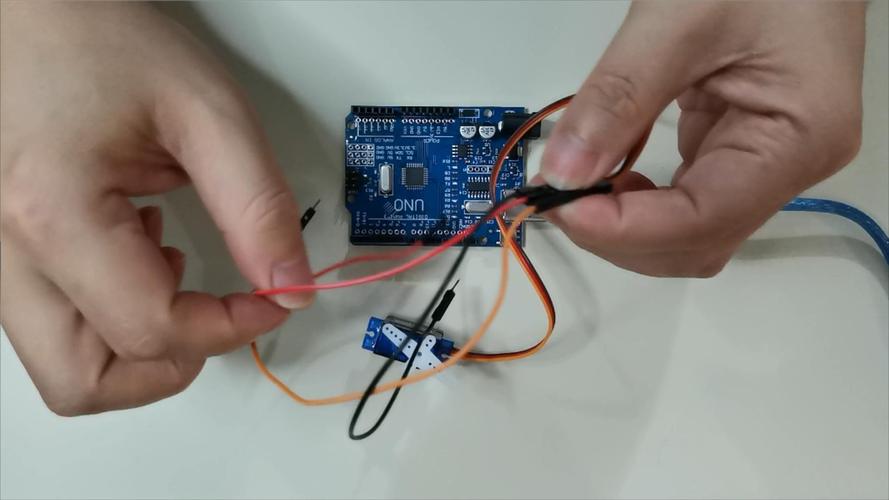
If you are supplying power directly, such as in a microcontroller project, you need to connect the positive and negative poles of the servo to the corresponding power supply: the red wire is connected to the positive pole of the 5V power supply, the brown/black wire is connected to the GND (negative pole) of the power supply, and the signal wire is connected to the PWM output pin of the microcontroller. A special reminder here is that if you drive multiple servos, the current will be very large. Do not press the power supply line and signal line on the poor 5V pin of the microcontroller. You must connect an independent 5V power supply to the servos, and connect the power supply and the GND of the microcontroller to the same ground (connected together).
After figuring out the power supply, the final signal line is simple. Among the three wires,the one that is neither red nor brown/black is the signal wire.It is usually orange, white or yellow. This wire is not responsible for power supply, it only transmits control signals. In the aircraft model receiver, it transmits a PWM wave (pulse width modulation signal), telling the servo "how many degrees you want to turn."
This wire is very fragile and is afraid of interference and short circuit. If you accidentally connect the signal line to the positive terminal, although it is not as dangerous as a direct short circuit, it may cause the servo to vibrate abnormally or rotate randomly. In severe cases, it may also damage the control chip of the servo. Therefore, when plugging and unplugging the servo cable, make sure that the plug is inserted all the way without any false connections, and do not let the exposed pins touch each other, especially the signal line and the positive electrode next to it.
To prevent reverse plugging, the most practical way is to use the plug’s “physical anti-fool” design. A standard servo plug will have a small slope or bump on one end, while the socket on the receiver or flight controller will have a notch or baffle in the corresponding place. When inserting, as long as the direction is correct, you can push it all the way; if the direction is reversed, it will not be inserted. Never use brute force to poke, otherwise the pins or sockets will be broken, which will make repairs very troublesome.
In addition, if you often need to plug and unplug equipment from different manufacturers, you may consider developing a checking habit:before plugging in, first look at the markings on the board, then look at the color of the wire, and make sure both are correct before proceeding.You can also use a marker to put a small red dot on the back of the servo cable plug (the side without the pin) to mark it as the positive pole, so that you can see the direction clearly at a glance the next time you plug it in. These little habits can help you save a lot of wasted money on buying a new steering gear.
Okay, regarding the distinction between servo lines, the core is to remember the color correspondence and learn to read the markings on the equipment. Now if you look at the steering gear in your hand, do you think it is much clearer? I would like to ask everyone, when you are playing with models or doing electronic production, have you ever experienced "smoke" due to wrong wiring? Welcome to share your "rollover" story in the comment area, let us have fun together, and give newbies a warning! If you find the article useful, don't forget to like and share it.
Update Time:2026-02-27

Contact Kpower's product specialist to recommend suitable motor or gearbox for your product.