TECHNICAL SUPPORT


Published 2026-03-05
What is the most troublesome thing when engaging in product innovation or small projects? I guess nine times out of ten it's stuck at the "action execution" step. If you want to turn your ideas into reality and make a certain part move, such as turning a car remotely, waving a robot, or turning a smart home camera, then you need a reliable little helper. The SG90 9g microservoset we are going to talk about today is specifically designed to solve this problem. It is small in size and powerful. The key is that it is very easy to use and can make your ideas that are stuck on the drawings come to life immediately.
Simply put, this is a kit that allows you to use electronic signals to control the precise rotation angle of a small motor. SG90 is a very classic microservomodel, weighing only 9 grams, so it is called 9g servo. This brand makes it into a set, which usually includes several servos, as well as matching screws, steering wheels and other small parts. Its working principle is that you can imagine it as a miniature version of a "rotating steering wheel". You give it a signal through the main control board (such as a Raspberry Pi), and it can accurately rotate the output shaft to the angle you want, such as turning the wheels of a model car 30 degrees, or raising a robotic arm.
Its scope of application may be much wider than you think. The most common one is used in various DIY robots, whether it is a small bipedal robot or a simple robotic arm, it is inseparable. Many model aircraft enthusiasts also use SG90 to control the tail of small fixed-wing aircraft. In terms of smart homes, some people use it with sensors to make automatic window openers, or add automatic watering device switches to flowerpots. Some friends who are engaged in creative arts even use servos to make their installations move. Basically, as long as there is a scene that requires a small object to rotate back and forth within a certain angle (usually 180 degrees), this set can come in handy. The threshold is so low that even middle school students can tinker with a work in their spare time.
We have to look at its parameters realistically. As an entry-level servo, SG90 has a "power" of about 1.6 kg/cm. What does that mean? Simply put, it can lift 1.6 kg of objects 1 cm away from the axis. This force is sufficient for driving plastic parts and light wooden boards. Its rotation speed is about 0.1 seconds/60 degrees, and the response is very sensitive. But one thing you have to pay attention to is that it uses plastic gears inside, not metal. This means that it is not suitable for occasions that need to withstand huge force or operate at high speed. After all, you get what you pay for. But for beginners to do experiments and verify ideas, this performance is very stable and enough to help you complete most basic actions at a low cost.
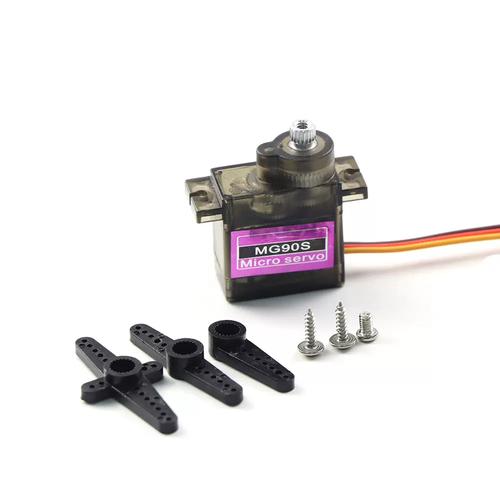
Don't worry that the wiring will be complicated, it's actually very simple. The SG90 servo usually has three wires: the brown one is usually the ground wire (connected to GND), the red one is naturally the positive power supply (usually connected to 5V), and the orange one is the signal wire (connected to the digital pin of the controller). You only need to connect these three wires correspondingly, and the physical connection is basically completed. The set usually also comes with some different types of steering wheels, which are small accessories installed on the steering gear shaft. There are cross-shaped and disc-shaped ones. You can choose the appropriate steering wheel according to your connecting rod structure and tighten it with the matching small screws. Remember, check the wiring again before turning on the power to make sure the positive and negative poles are correct. This is the "iron rule" for all electronic experiments.
For novices, another advantage of the servo is that the software support is very mature, and there are a large number of tutorials and ready-made code libraries online. If you use it, you only need to call a library file called "Servo.h" in the program and write two lines of code, such as ".write(90);", to make the servo turn to 90 degrees immediately. After the entire process, you may spend more time understanding the principles than actually writing code. You only need to prepare a main control board (Uno is the most common), a breadboard and a few DuPont wires to start your first experiment. This kind of "what you see is what you get" feedback will give you a special sense of accomplishment and motivate you to continue to do more complex functions.
When a novice starts playing, it is inevitable that the servo will not move or vibrate. The most common reason is insufficient power supply. The SG90 requires a relatively large amount of current at the moment of rotation. If you directly use the 5V output to power more than two servos, it will easily fail, causing a restart or the servos to shake randomly. The solution is very simple. ️Preparea separate external power supply for the servo, such as a few AA batteries, and then connect the ground wire of the power supply and the ground wire of the servo together. Another problem is that the angle is inaccurate. This may be because the steering wheel you are using is not installed in place, or the pulse width range in the code does not match. Calibrating the parameters in the library file can solve the problem. Don’t panic when you encounter problems, check them step by step, this is also part of learning.
In fact, the biggest significance of using the SG90 servo set is that you can break the "static" state with your own hands and let your ideas start to "move". It's like a Swiss Army Knife in your creative toolbox. Although it's not expensive, it's very practical and can help you solve many practical motion control problems. When you successfully turn the first servo, the joy and inspiration for the next step often follow.
Having said all that, I wonder if you happen to have a small project on hand right now that you have shelved because you don’t know how to get it started? Welcome to leave a message in the comment area to share your "stuck" experience. Let's think about it together. Maybe this set of small servos can be your savior! If you find the article useful, don't forget to give it a like and share it with friends who also like to tinker.
Update Time:2026-03-05

Contact Kpower's product specialist to recommend suitable motor or gearbox for your product.