







TECHNICAL SUPPORT


Published 2026-03-11
When you first started playing with 360-degreeservos, did you have the same idea as me, that it could rotate several times as smoothly as an ordinaryservo? However, after plugging it in for some testing, I was surprised to find that it just kept spinning in place and couldn't stop at all, let alone spin a few times. What exactly is this situation? Today I will take you through this issue thoroughly.
You probably know something about ordinaryservos. They can rotate to specified angles, such as 0 degrees, 90 degrees, and 180 degrees, and then stay firmly in the corresponding position. However, the operating logic of the 360-degree servo is completely different. It lacks a "potentiometer" for position feedback. Because of this, it has no way of knowing where it has rotated.
Because there is no position feedback, the 360-degree servo cannot tell you how many turns it has made. It only knows one command: full speed forward, full speed reverse, or stop. The signal you give it actually controls its rotation direction and speed, not the angle.
Since it doesn't know how many turns it has made, do we have no control over how many turns it makes? Of course not! We can use external methods to "help" it calculate the number of laps.
The simplest way is to rely on time. For example, when you give it a signal that it is rotating forward at full speed, and the signal lasts for 1 second, it may rotate 5 times during this period. You only need to control the duration of this high-level signal, and you can roughly control the number of turns it makes.
Of course, this method is not very accurate. The reason is that there are differences in voltage and load conditions, which in turn lead to changes in speed.
If you need to control the servo to turn a few turns very precisely, you need to add "eyes" and "brain" to it. The so-called "eye" is an encoder that can be installed on the rotating shaft of the steering gear to record the angle it turns in real time.
And the "brain" is your main control board, like that. The main control board continuously sends PWM signals to the servo to control its rotation. At the same time, it reads the position information fed back by the encoder to form a closed-loop control. In this way, the main control board can clearly know the number of turns of the servo.
Adding an encoder to a servo may sound complicated, but in fact there are many ready-made modules online. You can buy a magnetic encoder, stick the magnet on the steering gear shaft, and then fix the sensor on the steering gear housing, so that when the shaft rotates, the sensor can output a pulse signal.
Your main control board only needs to read these pulses and convert them into angles to know the current position of the servo. After that, you can write a simple program, such as "let the servo rotate forward 10 times." At this time, the main control board sends an instruction to rotate the servo, and at the same time pays close attention to the encoder data. Once it reaches 10 turns, it immediately sends a signal to stop it.
During the rotation of the servo, the main control board continuously monitors the changes in each pulse signal. When the number of pulses accumulates to a value corresponding to 10 circles, the main control board accurately captures this moment and quickly sends a stop signal. The whole process was smooth and accurate. The servo completed 10 forward turns according to the programmed setting, and then stopped smoothly, waiting for the next instruction to arrive.
After adding the encoder, the original "silly" servo that only knew how to simply turn in circles has undergone significant changes. It has transformed into an actuator with intelligent features. With the capabilities given by the encoder, it is no longer limited to simple circular motion, but has richer functions and more precise control.
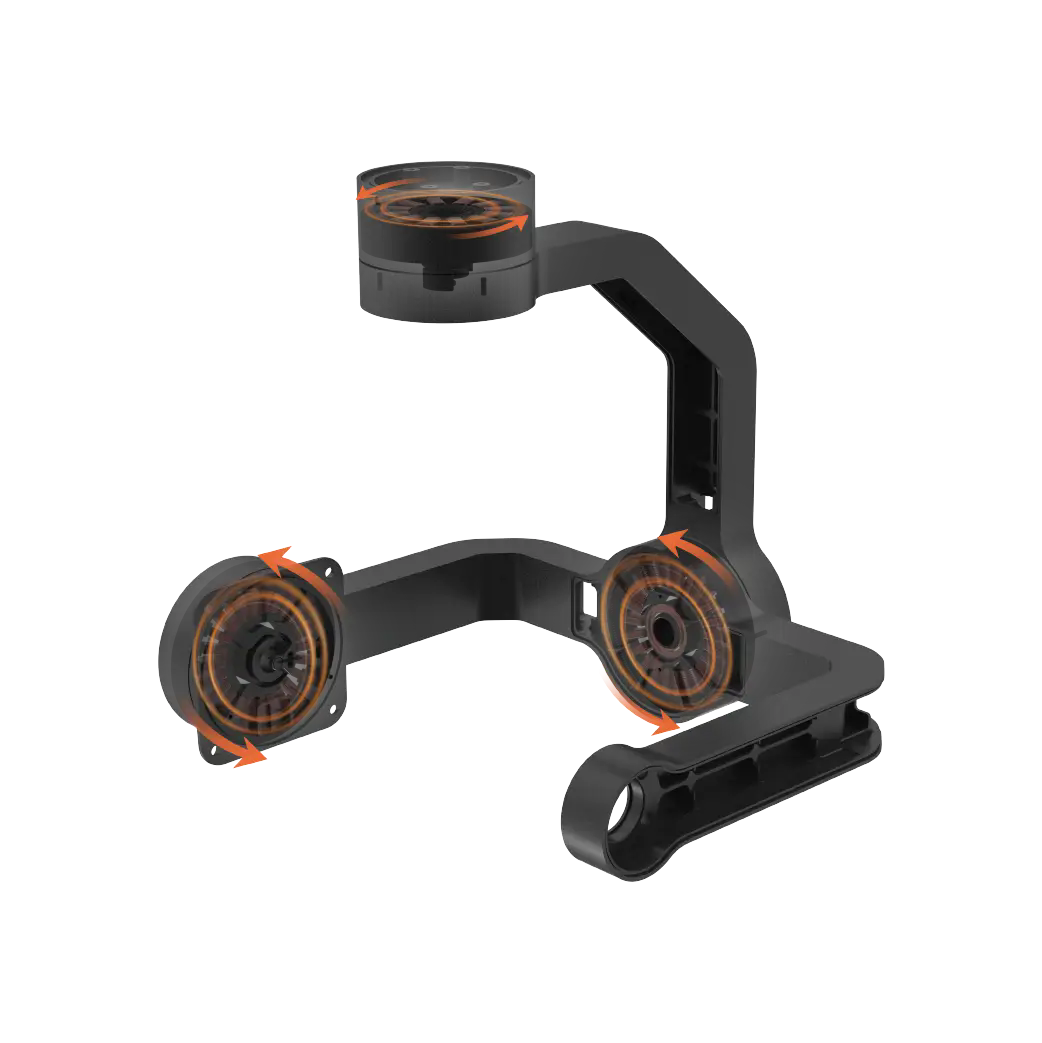
You can make full use of this smart actuator to carry out many interesting projects. For example, make a pan/tilt that can achieve precise angle adjustment. Through the feedback of the encoder, the pan/tilt can accurately position and rotate to meet various shooting needs; or create an automatic curtain opening and closing mechanism. With the precise control of the encoder, the curtains can open and close smoothly and accurately, bringing convenience to life.
The core benefit is "knowing what's going on". You no longer have to worry about how many turns it makes or how many turns it takes, because the main control board is always watching it. This is an essential upgrade for creative products that require precise, repetitive movements.
If you are planning to launch a new product project or a complex steering gear project, you must think carefully when making the selection. If you just want the wheel to continue to rotate, then an ordinary 360-degree servo will be enough. However, if you need it to turn a specific number of turns or stay in a certain position accurately, you have to consider buying a servo with an encoder, or choose to modify it yourself.
️ First, clarify your control accuracy requirements, whether it is roughly equal, or whether it is within one circle.
️ Second, calculate your budget and development time. Buying a ready-made servo with an encoder will be more expensive, but it saves trouble; modifying it yourself is the opposite.
After reading this, do you have a clearer idea about the project at hand? Are you going to use the timing method to get by for the time being, or are you going to add an encoder to the servo and try some more technical operations? Feel free to speak freely in the comment area and talk about your specific application. Maybe I can provide you with some feasible suggestions! If you find this content helpful to you, don’t forget to like it and share it with more friends who are keen on playing with servos!
In this way, everyone can communicate and discuss together, generate more sparks of inspiration about steering gear applications, and further promote the innovative practice and development of steering gears in various projects. Let us continue to explore more possibilities while playing with servos, jointly improve our understanding and application capabilities of servos, and inject more creativity and excitement into our respective projects.
Update Time:2026-03-11

Contact Kpower's product specialist to recommend suitable motor or gearbox for your product.