







TECHNICAL SUPPORT


Published 2026-02-14
Friends who play RC models, do you often encounter situations like this: the aircraft suddenly loses control of the control surface in the air, or the climbing car turns sluggishly on the rocks, and finally watches the car fall down? Nine times out of ten, these problems all arise from that little steering gear. Especially for the micro level of 1.5g, it is often difficult to balance power and accuracy. Today we will talk about AGF’s new C1.5CLS 1.5g ultra-miniature digital Corelessservoto see if it can solve our pain points.
Many friends who are just getting started think that they can install theservocasually because it is small. In fact, this is a big misunderstanding. Because the internal space of micro servos is extremely limited, the gears and motors are very delicate. When we fly small indoor planes or do micro-climbing, frequent vibrations and instantaneous high current shocks can easily cause ordinary servos to sweep their teeth or burn out directly. Especially the analog servo, which has slow response and consumes power, is a nightmare when used on models that require precise control.
The biggest highlight of AGF C1.5CLS is that it packs the two technologies of "digital" and "coreless" into a body as small as 1.5 grams. The advantages of digital servos are fast response, accurate positioning, and no false position like analog servos. The Core-less motor provides stronger torque and a smoother starting experience, which means that when your small aircraft is fine-tuning its direction, the response of the control surface is almost synchronous, and you can never go back to the feeling of control and hand control.
When equipping a miniature model with a servo, don't just look at the weight. ️Thefirst stepis to confirm how wide the servo signal is supported by your receiver or flight controller. AGF usually has a standard pulse width of 1.5-2.0ms. ️Thesecond stepis to estimate the torque required by the steering surface. The 1.5g-level steering gear has limited pulling force and is generally most suitable for indoor units with small steering surfaces or 1/24 micro-climbing. ️Thethird step, don’t forget to check the plug type to see if it matches your existing equipment.
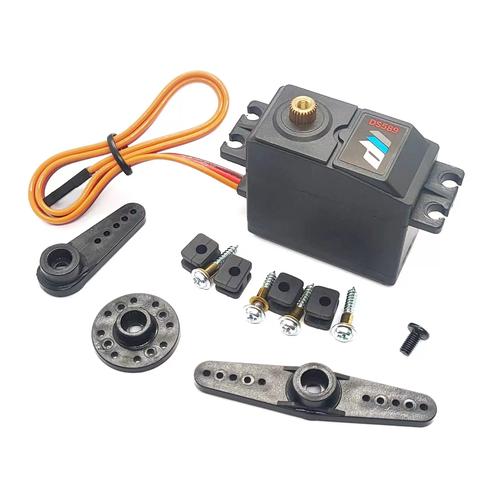
After replacing it with AGF C1.5CLS, the most intuitive feeling is "quiet" and "accurate". In the past, when using ordinary servos, I had to constantly correct the ailerons when the aircraft was hovering, which made my hands very tired. Now because its dead zone setting is very small and the neutral point is stable, the aircraft seems to be stationary in the air. When climbing over obstacles, the linearity of the steering is particularly good. You can precisely control the front wheel to turn only a little bit, instead of turning to the maximum angle like a switch. This is very helpful for micro-manipulating over stone gaps.
When installing this ultra-miniature servo, you must have a steady hand. First of all, the servo arm must be installed in a neutral position, otherwise the left and right strokes will be asymmetrical. Secondly, you must carefully check the positive and negative poles when wiring. Once the connection is reversed, the driver chip inside the servo will burn out instantly, and it will become a "disposable" one. Finally, don’t use too much glue when fixing the servo. A little hot melt glue or double-sided tape is enough. If it needs to be repaired or replaced in the future, it will be easy to remove.
If you are playing indoor 3D aircraft with a wingspan of less than 1 meter, or F3P (aerobatic flying) aircraft that are extremely weight-sensitive and require extremely high control surface response, then the AGF is definitely your first choice. There are also 1/24 scale mini climbing cars and mini drift cars. Because the cars are light in weight, they do not require high steering gear torque, but they have strict requirements on steering accuracy. Using this digital steering gear can also bring about a qualitative leap in control.
To be honest, this miniature digital Coreless servo is more expensive than an ordinary analog servo. But in the long run, it actually saves money. Because of its fast response and high accuracy, it reduces your crash rate during flying and driving. Moreover, Coreless motors do not have the iron core of traditional motors, so they have low starting current and low heat. The internal coreless motor structure works better with the digital control board, and its lifespan is usually much longer than that of brushed analog servos of the same level.
After seeing this, do you also want to upgrade the "little heart" of your car or airplane? You might as well search AGF’s official website to see the detailed parameters of C1.5CLS. I would like to ask everyone, what is the most troublesome servo problem you encounter when playing with miniature models? Is the rudder shaking, or is it weak, or is it burned out? Welcome to leave a message in the comment area, let's discuss and solve it together. If you find the article useful, don't forget to like it and share it with more model friends!
Update Time:2026-02-14

Contact Kpower's product specialist to recommend suitable motor or gearbox for your product.