







TECHNICAL SUPPORT


Published 2026-01-19
Have you ever encountered this situation - you are enthusiastically assembling your favorite, or debugging that small device that you have been imagining for a long time, and everything seems to be going smoothly. Then, you connected the little SG90 micro servo and fully expected it to accurately rotate to the specified angle. But the next second, it just buzzed feebly, or moved tremulously and then got stuck, completely disobeying the command. The frustration at that moment really made me want to sigh at the workbench.

This is probably not a problem of the "character" of the servo itself, but a detail that is often overlooked by us: voltage.
We can think of micro servos such as the SG90 as an extremely self-disciplined and sensitive little guy. It has a sophisticated feedback system inside that always compares the command position with the actual position. The energy that drives its core motor to rotate comes entirely from the voltage you supply it.
Voltage is to the steering gear what blood pressure is to the human body. If it is too low, there will be "insufficient blood supply", weakness, low torque, slow speed, and jitter (jitter) or even failure may occur due to insufficient power to support the internal control circuit. If it is too high, the "blood pressure will soar", the motor coil and internal chips will be overloaded for a long time, the heat will increase sharply, and the life span will be shortened quickly like a lit candle, or even "burned out" on the spot.
What does the often mentioned "standard operating voltage 4.8V ~ 6.0V" mean? It is actually a "comfort zone" defined by the manufacturer for you. Within this range, the servo can work stably and healthily with nominal performance (torque, speed). But please note that this does not mean that everything will be fine as long as it is within this range.
Many friends will say: "I am using a 5V USB power supply or voltage stabilizing module, which is obviously within the standard range!" The problem is often hidden here. Let’s break down a few scenarios:
"Strung Out" Voltage: Your power adapter is rated at 5V/2A, which sounds more than enough. But when the servo is started, especially when there is a load requiring greater torque, the current demand will surge. If the power supply line is too long and thin, or the power supply itself has poor dynamic response, the actual voltage reaching the servo pin may drop to 4.5V or even lower in an instant. This moment is a "power outage crisis" for the steering gear. This phenomenon is especially common when using one power supply to drive multiple servos.
"Dirty" power: If your power supply comes from a switching power supply, or shares a power supply with inductive loads such as motors and relays, there may be a lot of voltage spikes and noise on the power lines. These sudden high-voltage burrs are the "assassins" that penetrate the fragile chip components inside the steering gear.
"Fuzzy" intermediate value: You may be thinking, then I choose an intermediate value, is it safest to use 5.5V?理论上没错,但具体要看你的整体系统。如果你整板的其他元件(比如某些单片机、传感器)最高只能承受5V,那么为了一个舵机引入一组6V的电源反而会让系统复杂化。
Therefore, when choosing a power supply solution, you should not only look at a number, but also consider the "quality" and "stability" of the entire energy supply link.
After talking about so many issues, what is the correct way of thinking? In fact, it’s not that complicated. The key is to turn “extensive power supply” into “fine care”.
Step one: isolation and purification. This is the most effective move. Prepare a high-quality regulated power supply module for your steering system, separate from the logic power supply of the control system. If conditions are limited, at least connect a large-capacity (such as 470μF) electrolytic capacitor and a small-capacity (such as 0.1μF) ceramic capacitor in parallel at the servo power inlet. This large capacitor is like a small reservoir. When the steering gear needs a large current to start, it can "open the gate and release the water" in time to stabilize the voltage; the small capacitor is designed to absorb high-frequency noise. You will find that the chirping sound of the servo will immediately become calmer and much cleaner.
Step 2: Measure, don’t guess. Keep a multimeter handy. When the servo is running without load and with load, measure the real voltage on its pins. You will be surprised to find that "5V" on the circuit board and "5V" on the servo pins are often not the same thing. Seeing is believing, data is the best diagnosis.
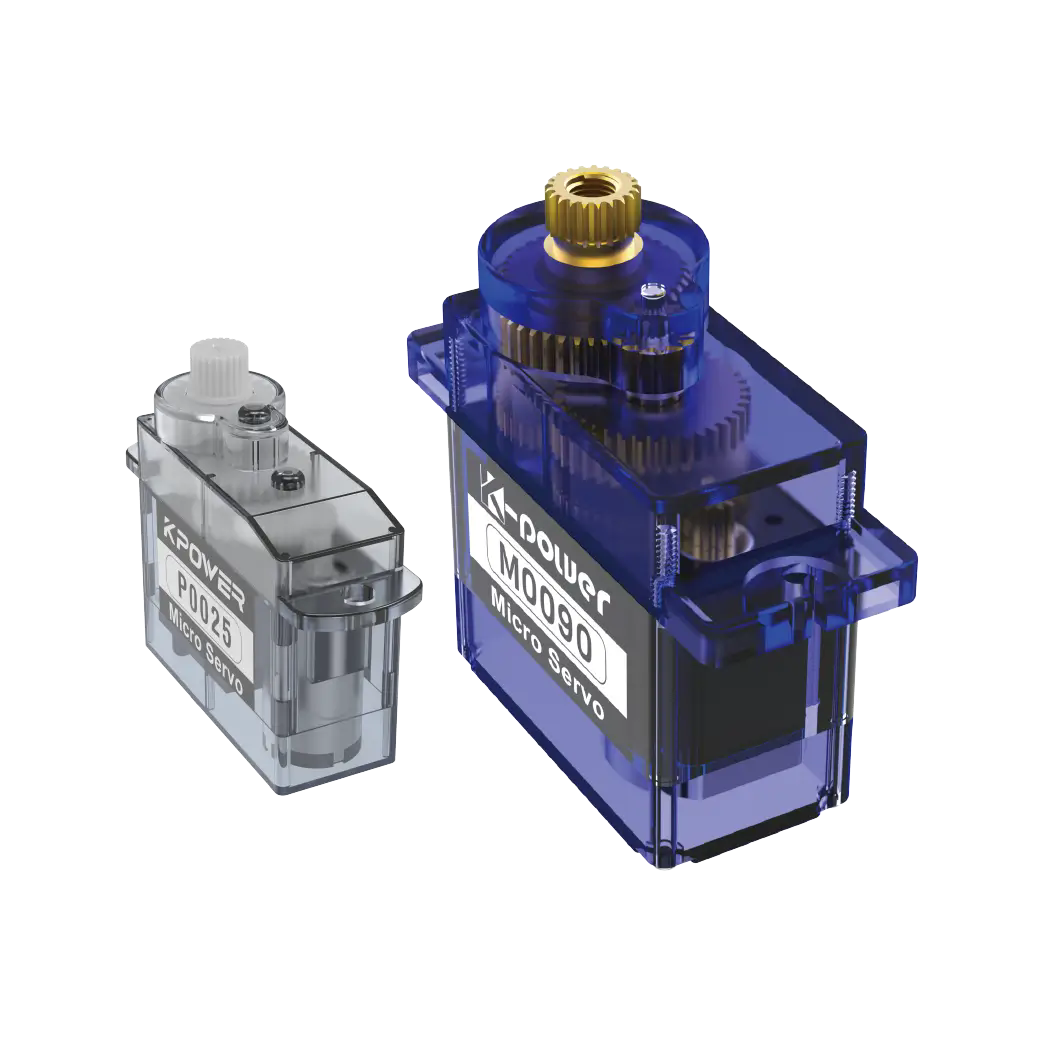
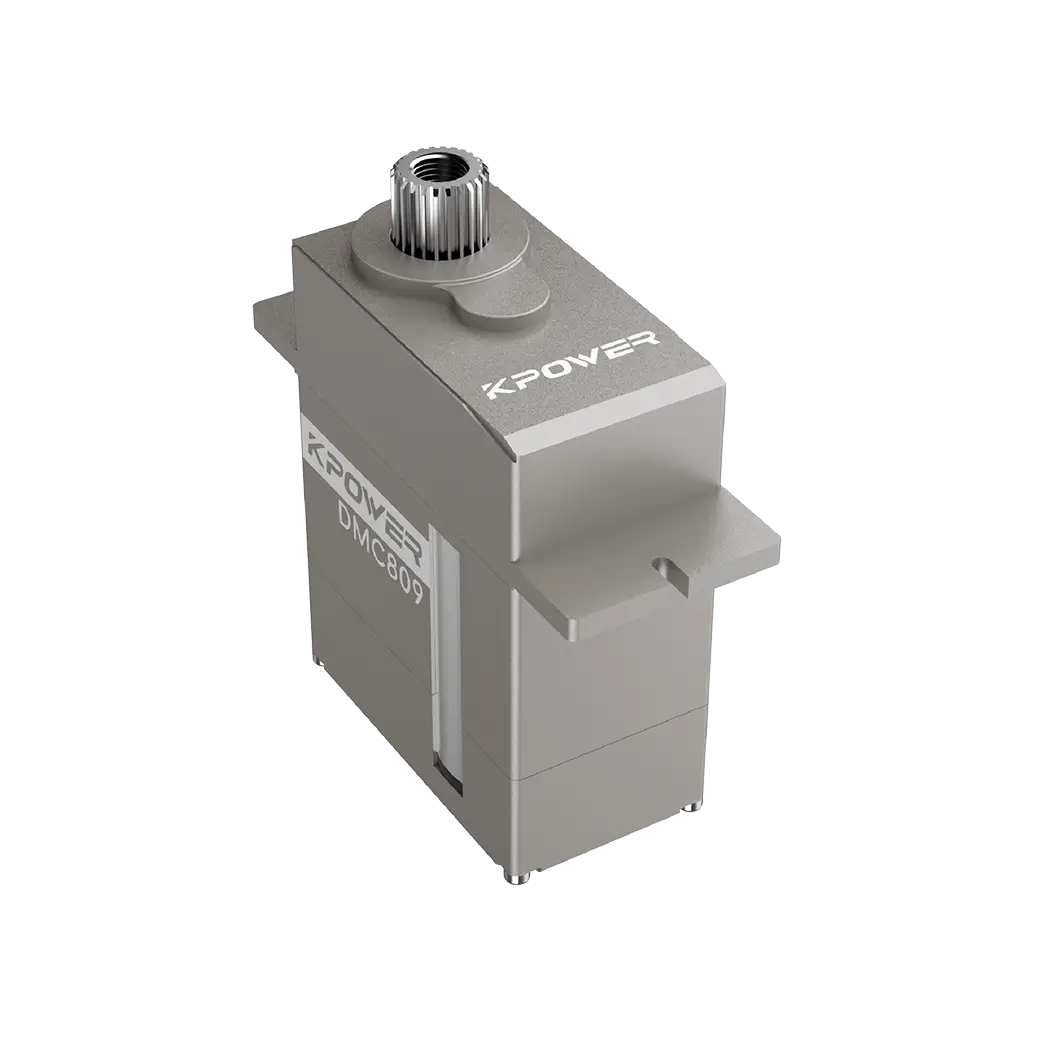
Step Three: Quality Selection. Speaking of which, we have to mention a basic point: Does the steering gear in your hand itself have a strong "heart"? The voltage resistance margin of the internal components, the material of the motor coil, and the accuracy of the gearbox all determine its ability to withstand adverse power supply environments. A servo that performs mediocrely under nominal voltage will hardly perform amazingly under any conditions. And a steering gear with excellent quality can allow you to fully experience the fun of precise control with stable power supply. Kpower has been investing extra attention in the core components and overall tolerance design of micro servos, striving to leave room for each standard parameter to cope with complex situations in the real world.
At the end of the day, the fun of playing with these tiny servos, or indeed any electromechanical project, is bringing an idea to life rather than constantly wrestling with unstable basic components. The voltage issue is just such a basic and critical link. It is not as logically beautiful as programming, nor as intuitive as structural design, but it is the cornerstone of all wonderful movements.
Next time you pick up that little SG90, you might as well take a few more minutes to think about it: Is the "energy environment" I provide it worthy of the sophisticated expectations I place on it? When you solve this underlying problem, you will find that whether it is a dexterous turn of the robot or a precise rudder deflection on the aircraft, it will become so reliable and smooth.
Real creation starts with a stable motivation.
Established in 2005, Kpower has been dedicated to a professional compact motion unit manufacturer, headquartered in Dongguan, Guangdong Province, China. Leveraging innovations in modular drive technology, Kpower integrates high-performance motors, precision reducers, and multi-protocol control systems to provide efficient and customized smart drive system solutions. Kpower has delivered professional drive system solutions to over 500 enterprise clients globally with products covering various fields such as Smart Home Systems, Automatic Electronics, Robotics, Precision Agriculture, Drones, and Industrial Automation.
Update Time:2026-01-19

Contact Kpower's product specialist to recommend suitable motor or gearbox for your product.