







TECHNICAL SUPPORT


Published 2026-01-19
Sometimes, the most troublesome thing is not the big complex problems, but something seemingly inconspicuous. For example, your robot arm always gets stuck when turning, or the steering of the remote control car is not very sensitive. You may have checked the program and adjusted the structure, but you didn't expect that the problem might lie in a part that weighs less than 10 grams - yes, that micro servo motor.

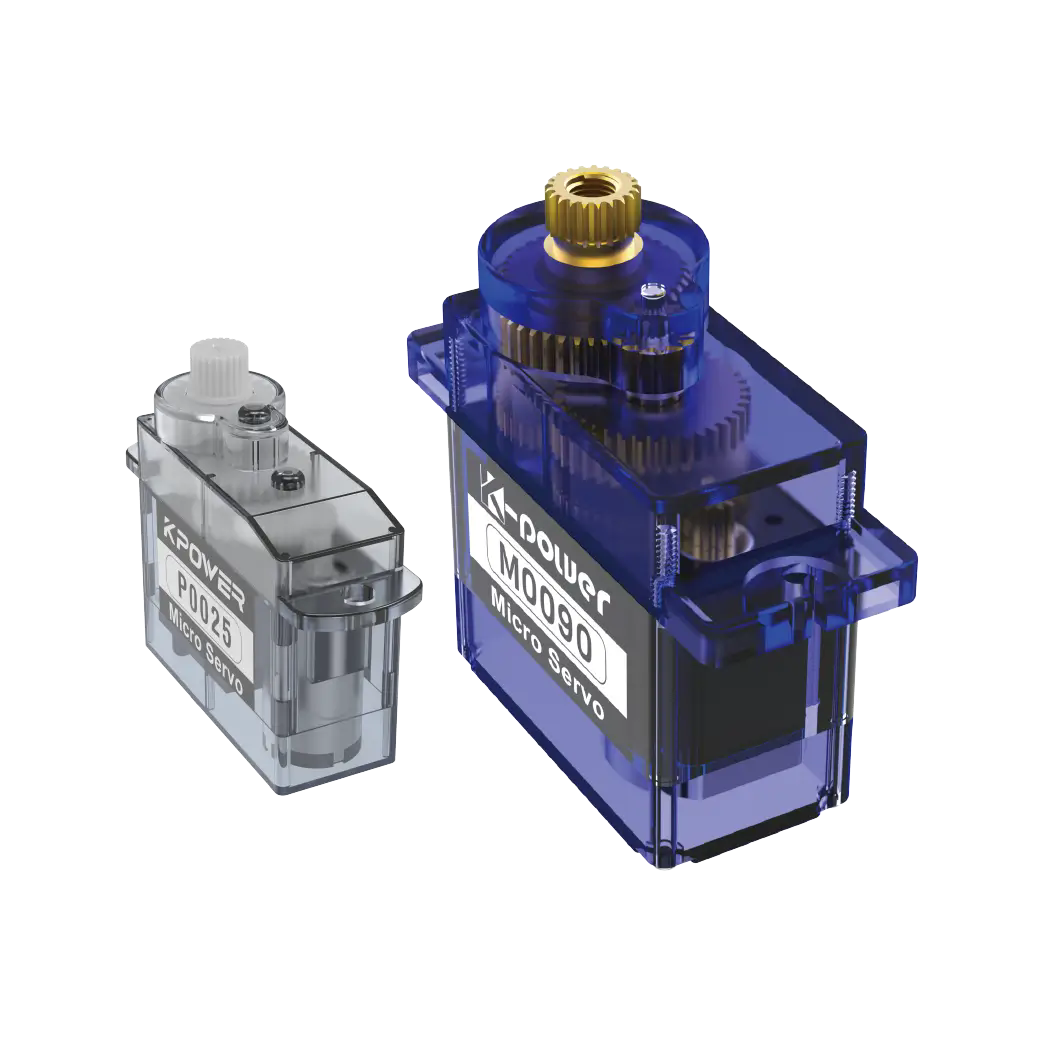
Many people are exposed to "tower pro micro" for the first timeservoWhen you use a 9g" micro servo, don't you think it's just a small motor? But after using it a few times, you find that things are not that simple. Some start to shake after a short time, some have insufficient torque at all, and some respond half a beat slower. You originally wanted the manipulator to grab something gracefully, but in the end it either shakes like a drunk person, or simply stops moving.
Imagine you're building a small drone, or a desktop robotic arm. Space is already tight, so every part has to be carefully considered. At this time, you need a micro servo that can accurately control the angle, respond quickly, and is durable enough. There are many choices on the market, but when you actually use them, the gap becomes clear.
Have you ever encountered that situation? When the motor turns to a position, it will quietly slide back a little. Or if the load is slightly larger, it will squeak and stop turning. What's worse is that after working continuously for a period of time, the heat becomes severe and the performance plummets. These problems are often related to the internal gear material, circuit design, and core components of the motor.
Therefore, when choosing a micro servo, you should not just look at weight and size. You have to see how it performs in real work situations.
Then there's the motor itself. The heart of the micro servo is the small DC motor. The rotation speed must be stable, the heat generation must be small, and the lifespan must be long. This involves the winding process and magnetic circuit design. In order to save costs, some servos use relatively ordinary magnets and enameled wires. They are okay at the beginning, but their efficiency decreases after a long time. A good design will allow the motor to maintain stable speed and torque under different voltages, and its performance will not be compromised due to a decrease in battery power.
There is also a control circuit. This is the brain part. Receive signals, drive the motor, and maintain position stability. Is the response speed fast enough? Is the dead zone setting reasonable? Will it drift due to temperature changes? These are things that we don’t usually pay attention to, but in actual use, they greatly affect the experience.
For example, you are building a small robot with a camera on its head to track objects. The robot needs to turn its head to follow the target. If there is jitter when the servo motor rotates, the camera image will keep shaking, making it difficult for tracking to work stably. If the rotation speed is uneven, sometimes fast and sometimes slow, it will be difficult to track. At this time, a micro servo with fast response and smooth movement directly determines the success or failure of the entire project.
Or you are making a small device for automatic watering flowers and need to turn a small valve regularly. If the position accuracy of the servo is not enough, the angle of rotation will be different every time, and the amount of watering will not be controlled accurately. If the motor consumes too much power, it may not last a few days on battery power. These details will only be exposed in practical applications.
The first is the operating voltage range. Some micro-servos are nominally 4.8V~6V, but the actual torque at 4.8V is obviously not enough, and 6V is required to work properly. A good product should have stable output within the nominal voltage range and will not force you to increase the voltage for performance.
The second is neutral point stability. It means that when the neutral signal is given, the motor can stop steadily and will not slowly drift by itself. This is important for situations where positioning needs to be maintained.
The third is temperature rise. Work continuously for half an hour and feel the temperature of the case. If it is hot to your hands, it means that the internal efficiency is not high, a lot of energy is wasted as heat, and high temperature will also affect the lifespan.
The fourth is signal response speed. Given a pulse signal, how long does it take for the motor to start responding? The shorter this time is, the easier it is to control.
You may not be able to see these points in the product parameter table, but in actual use, each one will affect the experience.
Once you get a new microservo, don't rush into fitting it into your project. You can test it individually first: gently turn the output shaft with your hand to feel the smoothness and gear clearance; connect the control board and let it rotate back and forth dozens of times to hear if the sound is smooth; try it at different voltages to see if the performance changes significantly.
When installing, do not tighten the fixing screws too much, especially models with plastic shells, which are prone to deformation. The connecting arm must be installed correctly and not be tilted to receive force. Try to avoid signal lines from power lines to reduce interference.
If it is used outdoors or in an environment with high vibration, you can consider adding some buffer material around the motor. This does not mean wrapping it, but adding some rubber pads at fixed points to reduce the directly transmitted vibration.
A good micro servo motor should be something that once you install it, you almost forget it exists. It executes every command quietly, reliably and accurately without losing its presence or causing trouble at every turn. You can focus entirely on the overall function of the project, instead of always worrying about whether a small part will fall off.
The success of a project often depends on the quality of these basic parts. They may not necessarily be the coolest parts technically, but they must be the parts that give you the most peace of mind. When you no longer need to worry about a certain rotating mechanism, you have more energy to think about more important designs.
Next time you're worried about that little turning motion, take a look back at that tiny servo that weighs less than 10 grams. Perhaps the answer to the question lies in this most basic part.
Established in 2005,kpowerhas been dedicated to a professional compact motion unit manufacturer, headquartered in Dongguan, Guangdong Province, China. Leveraging innovations in modular drive technology,kpowerintegrates high-performance motors, precision reducers, and multi-protocol control systems to provide efficient and customized smart drive system solutions. Kpower has delivered professional drive system solutions to over 500 enterprise clients globally with products covering various fields such as Smart Home Systems, Automatic Electronics, Robotics, Precision Agriculture, Drones, and Industrial Automation.
Update Time:2026-01-19

Contact Kpower's product specialist to recommend suitable motor or gearbox for your product.