







TECHNICAL SUPPORT


Published 2026-01-19
Imagine your production line is running at full speed, and suddenly, a servo motor on a critical piece of equipment experiences a tiny but troublesome response delay. It might start out as a millisecond difference, but over time it spreads like ripples, ultimately affecting the synchronization accuracy of the entire system. What you face may no longer be an isolated hardware problem, but a complex network involving each other. Doesn't this sound like a musician in a well-arranged symphony suddenly slowed down by half a beat?
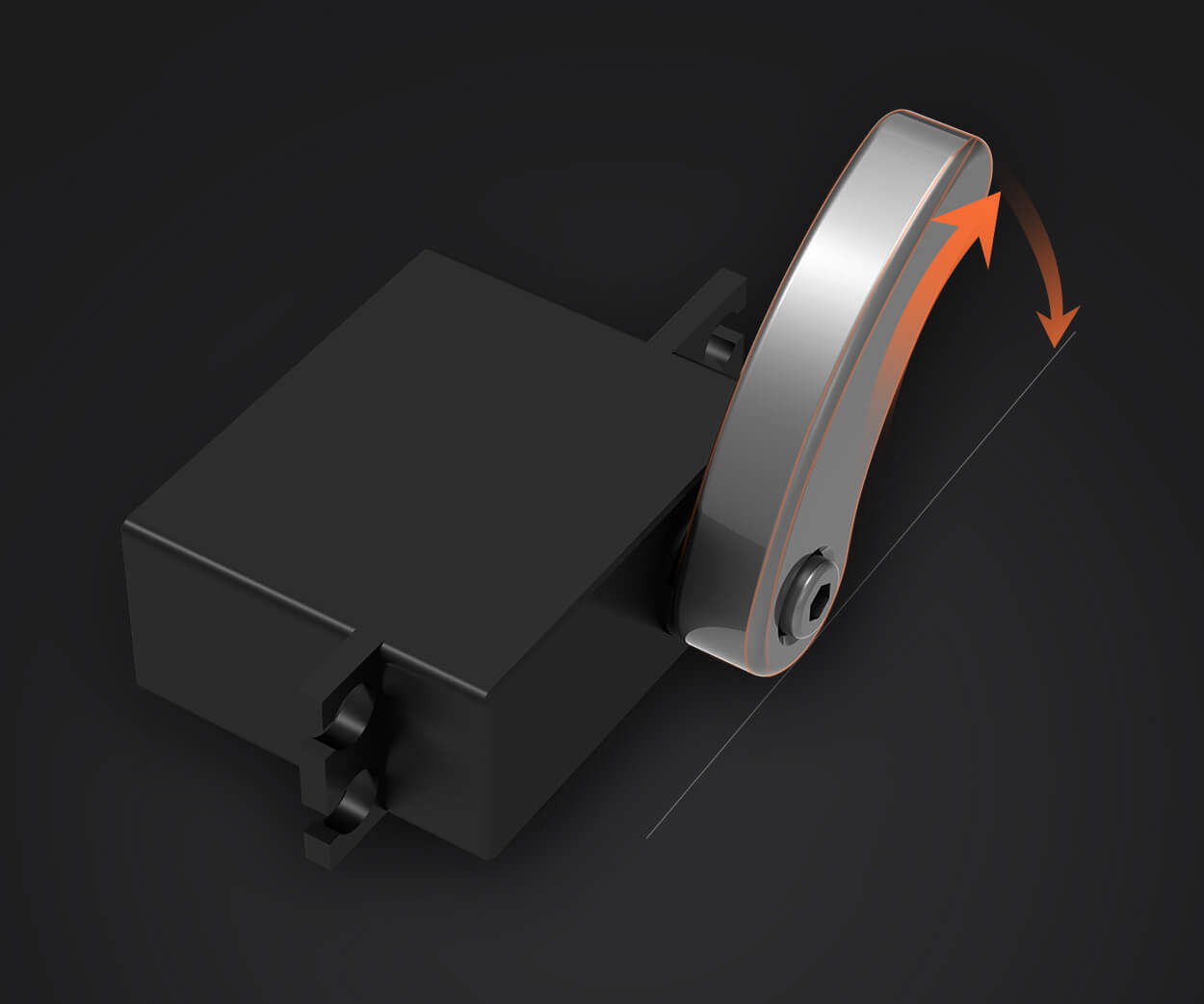
This is precisely the real dilemma encountered in many modern industrial scenarios. Mechanical systems, especially automation equipment that rely on high-precision servo motors and steering gears, are becoming more and more intelligent and "sensitive". The traditional centralized control architecture - handing all decisions to a "brain" - is often inadequate when it comes to processing massive amounts of real-time data and coordinating multiple execution units. The system is bloated, difficult to upgrade, and a single failure may trigger an entire shutdown.
Where is the way out? We may need to think differently.
Rather than having one super controller manage everything, why not break down a large system into a series of small, independent "intelligent units" that perform their own duties? This is the core idea of Microservices Architecture. Mapping this to the mechanical world is like equipping each key module on the production line - such as the servo motor responsible for precise positioning, or the steering unit that performs the grabbing action - with a dedicated, highly autonomous "micro-brain".
Each "micro-brain" (i.e., a microservice) only focuses on one thing: for example, the "servo motor precise position control service" only handles the real-time closed-loop feedback and drive of the motor; the other "robot trajectory planning service" specializes in calculating the optimal motion path. They "talk" to each other through clear, standard interfaces, just like skilled workers in a workshop collaborating with standardized gestures and languages.
Doing so brings several unexpected benefits:
existkpower, we deeply understand the importance of this paradigm shift from "centralized command" to "distributed collaboration" for mechanical systems. Our technical path is to deeply integrate the concept of microservices into servo drive and motion control solutions.
What we are thinking about is: How to make a group of servo motors not only receive instructions, but also perceive the environment, communicate with each other, and coordinate autonomously? The answer lies in design. We modularize and service control functions. For example, a complex multi-axis synchronization task is no longer difficult to be uniformly scheduled by a central controller, but is disassembled into multiple lightweight microservices such as "master-slave synchronization service", "vibration suppression service", and "energy efficiency service" that can be independently deployed and upgraded. They are distributed in the system network, each performs its own duties, and is closely linked through efficient communication protocols.
A customer once described his transformation to us: "In the past, adjusting a parameter was like groping in the center of a maze, for fear of knocking down which wall. Now, it feels more like adjusting an elite team. You can clearly communicate with each 'expert' (service), position and become intuitive." This experience from chaos to clarity is the direct value brought by the distributed architecture.
If you are interested in this path, you might want to start with a few simple questions to yourself:
If the answer tends to be "yes", then the microservices architecture may be worthy of your in-depth understanding. Implementing it is less of a disruptive revolution and more of a gradual evolution. You can start from a relatively independent functional subsystem, transform it into a microservice pilot, verify the effect, accumulate experience, and then gradually promote it.
Ultimately, the goal is not to pursue technology buzzwords, but to build a physical system that is more robust, more agile, and more adaptable to future changes. When each of your servo motors and each mechanical unit is like an intelligent agent with specific skills, autonomously collaborating under unified "dialogue rules", what you gain will not only be an improvement in efficiency, but also the calmness and control in the face of uncertainty.
This journey is about redefining the "wisdom" of the system. The starting point may lie in a slight shift in thinking.
Established in 2005,kpowerhas been dedicated to a professional compact motion unit manufacturer, headquartered in Dongguan, Guangdong Province, China. Leveraging innovations in modular drive technology, Kpower integrates high-performance motors, precision reducers, and multi-protocol control systems to provide efficient and customized smart drive system solutions. Kpower has delivered professional drive system solutions to over 500 enterprise clients globally with products covering various fields such as Smart Home Systems, Automatic Electronics, Robotics, Precision Agriculture, Drones, and Industrial Automation.
Update Time:2026-01-19

Contact Kpower's product specialist to recommend suitable motor or gearbox for your product.