







TECHNICAL SUPPORT


Published 2026-01-19
Imagine this: the automated production line you spent several months designing has finally reached the joint debugging stage. But one Friday afternoon, the servo motor on the conveyor belt suddenly "strike" - instead of not moving at all, it "twitched" from time to time, as if it was doing a mechanical dance that no one could understand. Engineers huddled around, and the jumping curves on the data recorders looked like patients with abnormal electrocardiograms. What's the problem? temperature? load? Or is it the communication protocol that no one can explain clearly?
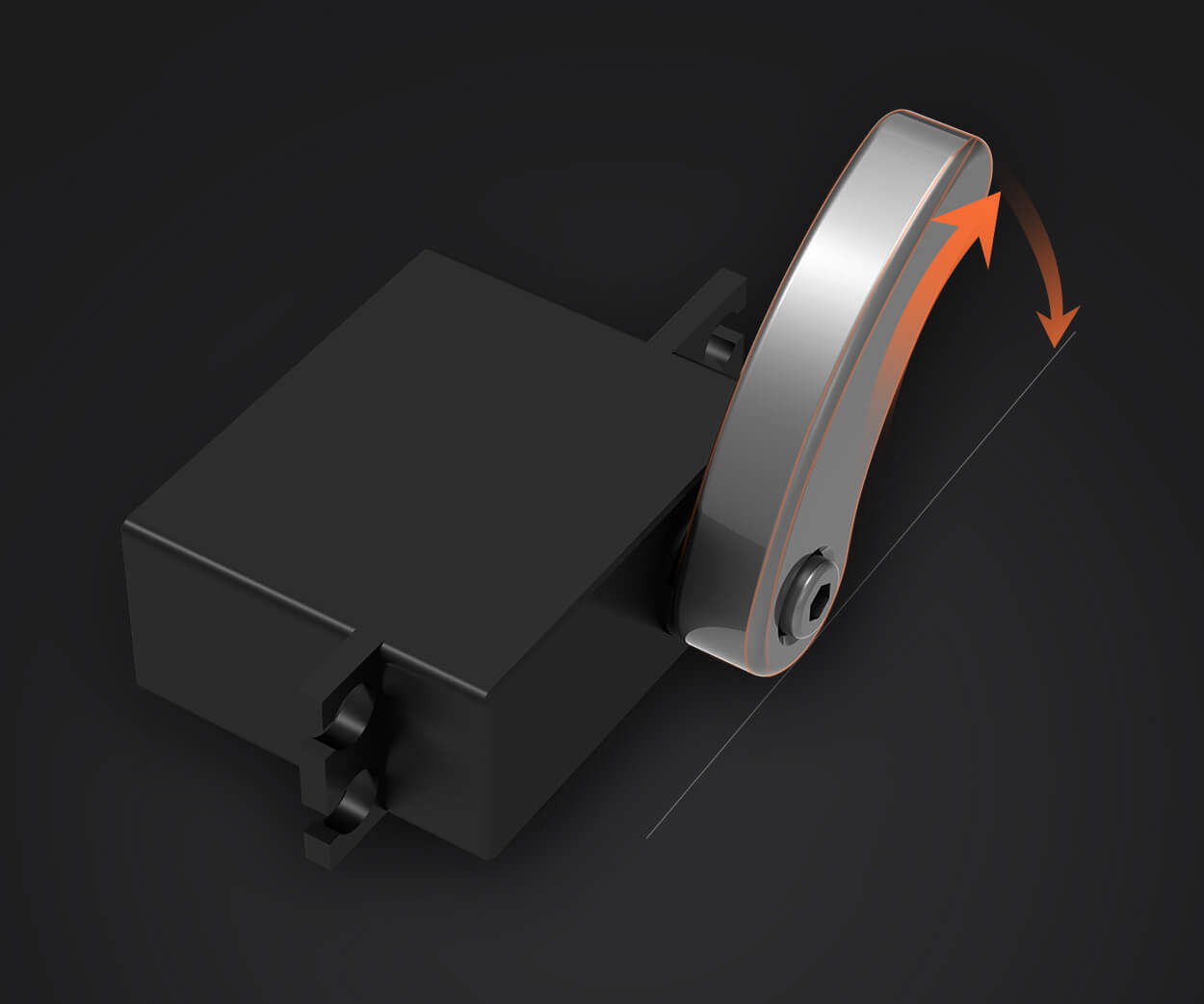
This situation is all too common. What you need may not be to replace the entire motor, but someone to tell you what that 0.01 second signal delay actually means.
Every piece of equipment in operation speaks. The servo motor feeds back its position through pulses, the servo uses its angle to tell you its status, and the PLC is constantly broadcasting data packets. The problem is, these "conversations" are in different languages, occur on different frequencies, and happen too fast for the human ear to pick up.
Traditional maintenance methods are like guessing: Is the temperature too high? Add some lube. Too much shock? Tighten the screws. But many times, the root cause of the problem is hidden in those tiny digital signals - a timing deviation in an instruction, an overflow of a memory, or an accidental misreading of a sensor.
"We used to solve the 'symptoms'," said a veteran worker who has been in the factory for twenty years. "For example, if the motor overheats, we add a fan. But later we found that the overheating was because a certain control command was sent seventeen times when it shouldn't have happened. You can't see those seventeen repetitions, you can only see the number on the thermometer climbing up."
That's what micro-information technology services do: translate the "whispers" of those devices. It’s not about replacing hardware, it’s not about overturning the original design, it’s about understanding the digital details that were originally ignored.
For example, the "dancing" servo motor. By monitoring its real-time data stream, technicians found that whenever another large stamping machine in the workshop was started, there would be interference in the motor's control signal for about 2 milliseconds. It is not a power supply problem or a mechanical failure, but coupling interference that was not expected during the electromagnetic compatibility design. ? Instead of spending tens of thousands of yuan to add a shield next to the motor, the grounding method of the controller was adjusted and the start-up sequence of the stamping machine was rearranged.
"Sometimes you think it's a mechanical problem, but it's actually telling you an electrical story; sometimes you think it's a software bug, and you find that the resistance of a certain connector is 0.5 ohms higher."
How to start this conversation? There is no need to dismantle the entire production line and start over.
The first step is a "physical examination". Install lightweight monitoring modules at key nodes - these modules are small enough to be attached to the motor housing without interfering with the original operation. They don't control anything, they just listen quietly and record those pulses, voltage fluctuations, temperature curves and communication data.
The second step is "translation". Look at consecutive weeks of data together and look for patterns. The normal vibration curve is like a regular wave, but some new frequency components will quietly appear in the vibration signal of a bearing that is about to fail, like someone suddenly out of tune in a choir.
"The most interesting thing is to compare the data between 'healthy' and 'sub-healthy' states," shared the technician in charge of such projects. "Just like a person's throat will become dry before a cold, the 'voice' of the data of the machine will also become mute before it completely breaks down."
The third step is to “prescribe”. It might be adjusting a parameter, it might be replacing a specific batch of cables, or it might be simply cleaning the dust off the encoder. In most cases, the cost is less than one-tenth of the cost of replacing the equipment.
Because machines don't lie. Each of its tiny reactions corresponds to a certain physical state. The problem is that we didn’t have a detailed enough method to “ask” it in the past, nor were we patient enough to “listen” to its complete answer.
What micro information technology services provide is such a set of "question and answer tools". It is based on several simple cognitions: most failures have precursors, which are hidden in the data; the interaction between different components is often more complex than we imagine; the cost of prevention is always lower than repair, and even lower than stopping production.
"We once helped a packaging factory reduce unplanned downtime of a robotic arm by 75%. Method? After analyzing its movement data for eight months, we found that the repeatability accuracy of a certain angle would begin to decay after four hours of continuous operation. It was not the wear of the parts, but the viscosity of the grease that would change at that specific temperature. After changing to another grease, the problem disappeared."
andkpowerThe focus in this area is based on the understanding that every tiny piece of information deserves to be respected, and behind every signal there may be a story about efficiency, safety or cost. Their job is not to simply provide monitoring equipment, but to establish a framework for understanding machine language so that the otherwise silent steel can begin to speak about their needs.
Just like a good mechanic can tell the condition of an engine by the sound of a knock, modern digital services allow engineers to predict the health of the entire system through data streams. The difference is that the latter is earlier, more precise, and can provide hints before the problem becomes a "problem."
Next time you see a production line running smoothly, maybe think about it: Those quiet motors and drives may be telling a story about precision, collaboration, and prevention through a string of 0s and 1s. And someone is listening carefully.
There should always be some revelation at the end of the story: many times, progress does not come from bigger motors or stronger steel, but from more careful observation and the patience to be more willing to listen. Whether it’s a machine or a human, this seems to make sense.
Established in 2005,kpowerhas been dedicated to a professional compact motion unit manufacturer, headquartered in Dongguan, Guangdong Province, China. Leveraging innovations in modular drive technology,kpowerintegrates high-performance motors, precision reducers, and multi-protocol control systems to provide efficient and customized smart drive system solutions. Kpower has delivered professional drive system solutions to over 500 enterprise clients globally with products covering various fields such as Smart Home Systems, Automatic Electronics, Robotics, Precision Agriculture, Drones, and Industrial Automation.
Update Time:2026-01-19

Contact Kpower's product specialist to recommend suitable motor or gearbox for your product.