







TECHNICAL SUPPORT


Published 2026-03-18
Have you ever encountered a robot or gadget that you have carefully assembled, but theservokeeps shaking, or simply cannot turn? This is probably because the voltage is not correct. Although the microservois small, it is very sensitive to voltage. If it fails, it will not only affect the performance, but may also be scrapped directly. Don't worry, today we will talk about microservothoroughly.
For most common micro servos on the market, such as the classic SG90 or MG90s, their "comfort zone" is usually between 4.8V and 6.0V. This range is the standard working range given by the manufacturer after testing. You can think of it as the recommended tire pressure of the car. Within this range, the steering gear operates the most smoothly and has the longest life.
Below 4.8V, the motor inside the servo may become "powerless" and cannot drive the gear, resulting in inaccurate positioning, jitter, or even no rotation at all. And if you apply a voltage of more than 6.0V to it on a whim, such as directly to 7.4V, although it feels "infinitely powerful" at that moment, the internal circuit and motor will soon "die from overwork" due to overheating, and the price will be a puff of green smoke, saying goodbye to you completely.
The voltage level directly determines how much force the servo can produce, which is what we often call torque. It's like a faucet at home. The greater the water pressure, the stronger the water flow. The same is true for your servo. It may only be able to lift a small wooden block at 4.8V, but increase the voltage to 6.0V (within the allowable range), and it may be able to easily grab a battery.
This is very critical to your project design. For example, if you are making a robotic arm and find that it hangs down feebly after being lifted into the air, don't immediately suspect that the servo itself is broken. Use a multimeter to check whether the power supply voltage is low. Adjust the voltage upwards (still within 6V), and you will find that its "strength" instantly increases a lot, and its movements become more agile.
After talking about voltage, we have to talk about its "twin brother"-current. Voltage is thrust, and current is the "energy flow" that maintains this thrust. When the servo is blocked or needs to drive a heavy object, it will be like a very hungry person and need to draw in a large amount of current in an instant. If your power supply has a small "capacity" and cannot supply this current, the voltage will be pulled down immediately, and the servo will naturally start to twitch and shake.
Therefore, never use a mobile phone charger (which usually can only output 0.5A-1A) to drive several servos at the same time. ️The correct approach is to make an estimate first: Assume that one servo may consume 1A when locked, and you want to use 3, then you must prepare a power supply that can stably output at least 3A (preferably with a margin, such as 5A). Remember, a "strong" power supply is the cornerstone for the stable operation of the servo.
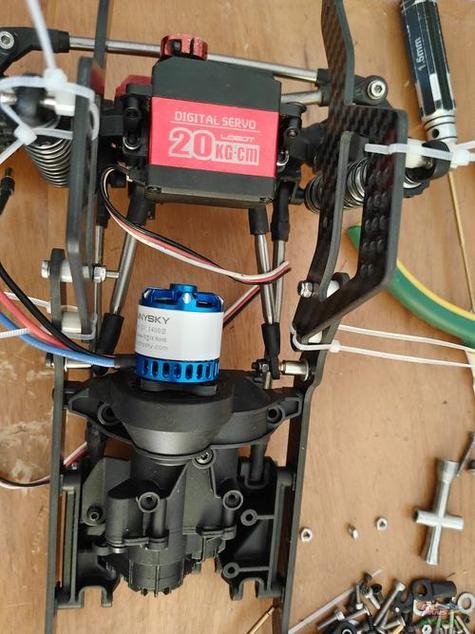
Many times, we only have readily available lithium batteries on hand, such as 7.4V or 11.1V batteries left over from drones, but the servo can only accept 6V. What should we do? Directly following that is "Murder". At this time, you need a voltage step-down module, which is like a voltage converter, converting high voltage into a low voltage that the servo can withstand.
️For the steering gear system, I strongly recommend using a switching regulator module (such as a module based on . Although it is a little more expensive than a linear regulator (for example), its advantage is that it has high conversion efficiency, generates almost no heat, and can continuously provide stable and large current for your multiple servos. Connect it between the battery and the servo, adjust the output voltage, and you can safely feed your "strong men".
This is a very classic question. The answer is: it can be used, but it is a matter of "making do" rather than "paying attention". If you connect a 5V servo to 3.3V, it can usually turn, but the speed and torque will be severely compromised. Apply the slightest amount of resistance and it might get stuck, which is completely unacceptable on a 3D printer or robotic arm that requires precise control.
However, there is a small detail worth noting here: many current control chips are 3.3V logic (like ESP32). Although the power supply to the servo is 5V, the control signal sent from the chip is 3.3V. Fortunately, most servos "recognize" this 3.3V signal level and can work normally. But if your servo responds slowly, you need to check whether you need to add a level conversion module to amplify the signal.
The symptoms of voltage instability are very obvious: the servo will vibrate, make a hissing sound, or move back and forth for no reason, making your entire work look extremely unreliable. This is usually caused by insufficient power from the power supply, a connecting wire that is too thin or too long, or a battery that is almost dead.
Here is a trick that costs almost nothing but has immediate results: connect a large capacitor in parallel between the positive and negative poles of the servo power supply. ️You can try soldering a 470 microfarad (uF) or even 1000 microfarad electrolytic capacitor. This capacitor is like a "small reservoir". When the steering gear suddenly requires a large current, it can instantly release the stored power and steadily support the voltage to prevent it from falling. This little trick can solve most jitter problems caused by voltage fluctuations.
What interesting pitfalls have you encountered in servo power supply? Or do you have any unique tips for stabilizing voltage? Welcome to share your experience in the comment area. If you think today’s content is helpful to you, don’t forget to like and share it with more friends in need!
Update Time:2026-03-18

Contact Kpower's product specialist to recommend suitable motor or gearbox for your product.