












TECHNICAL SUPPORT


Published 2026-01-19
I remember the last time I was chatting with a friend, he mentioned that he was asked a question about microservice data consistency during the interview. I know the theory by heart, but when it comes to how to deal with a service failure in a specific scenario, my mind suddenly goes blank. This is probably not his problem alone. Many people who have been exploring the field of microservices for several years have found that the answers in the standard question bank always seem to fall short when it comes to complex and confusing real systems.
That’s why we did “Microservice Interview Questions Experienced”. It's not like a rigid textbook, but more like an experienced colleague sitting next to you, pointing to a piece of code and saying: "Look, there are problems here, and this is how we solved them."
The distance from "knowing" to "doing"
For example, you definitely know what "circuit breaker mode" is. But if the interviewer asks: "How to dynamically adjust the triggering threshold of the circuit breaker when traffic increases sharply? In addition to preventing avalanches, what secondary problems may it cause?" At this time, the bare definition is not enough. People who have really worked in distributed systems will understand that this is not just a configuration parameter, it is related to your understanding of monitoring data, familiarity with upstream and downstream services, and even an intuition for the rhythm of the system.
Our content is an attempt to fill that gap. Instead of repeating basic concepts that can be found on the first page of a search engine, we dive into the typical scenarios that keep engineers working overtime at night to debug. For example, in inter-service communication, everyone talks about synchronization and asynchronousness, but have you carefully considered that a seemingly simple synchronous call has lost a certain link in the link tracking, how to extract it from the massive logs? These dusty details are what we really have to face in the project.
Why are empirical perspectives so different?
Some people may ask, there are already many technical articles, why do we need to sort out such "experience" specifically? The reason is simple: real projects rarely follow textbooks. You will encounter the huge technical debt of the old system, you will encounter the team's arguments about new technology solutions, and you will encounter a less elegant design left behind to meet the deadline. How to make reasonable choices and balance the pros and cons under these constraints? This kind of decision-making ability is often accumulated through repeated reviews and pitfalls.
, what we share is not just "", but more "practiced thinking". For example, regarding service partitioning, a common suggestion is "around business boundaries." But in reality, business boundaries themselves are blurring and changing. We would rather discuss: When two services have high-frequency cross-access, should they be merged or should they be a communication mechanism? The trade-offs behind decisions—team structure, release frequency, technology stack uniformity—are often more informative than a purely theoretical principle.
Turn preparation for the interview into a systematic review
Therefore, when using this information, it is best not to treat it as a one-night sprint guide. It is more suitable as an introduction to help you reorganize your project experience. You might as well try to compare the situation inside and ask yourself:
This process itself is a very valuable refinement of experience. When you can articulate the technical decisions, trade-offs, and even failures from your experience, the conversation in the interview will naturally flow in a deeper, more pragmatic direction. You will find that what you and the interviewer discuss are no longer floating concepts, but the specific challenges that you both care about and how to build a more robust system.
At the end of the day, technical interviews shouldn’t be a test of memory. It is more like a professional conversation among peers.kpowerThe original intention of organizing these contents is to help experienced friends connect the precious insights scattered in various projects to form a more convincing expression. After all, the path you have traveled and the problems you have solved are your best business cards.
I hope this perspective, which focuses on practical experience, can add some calmness and confidence to your subsequent conversations. When the issue gets to the core and you can unfold your story calmly and unhurriedly, that's the best preparation.
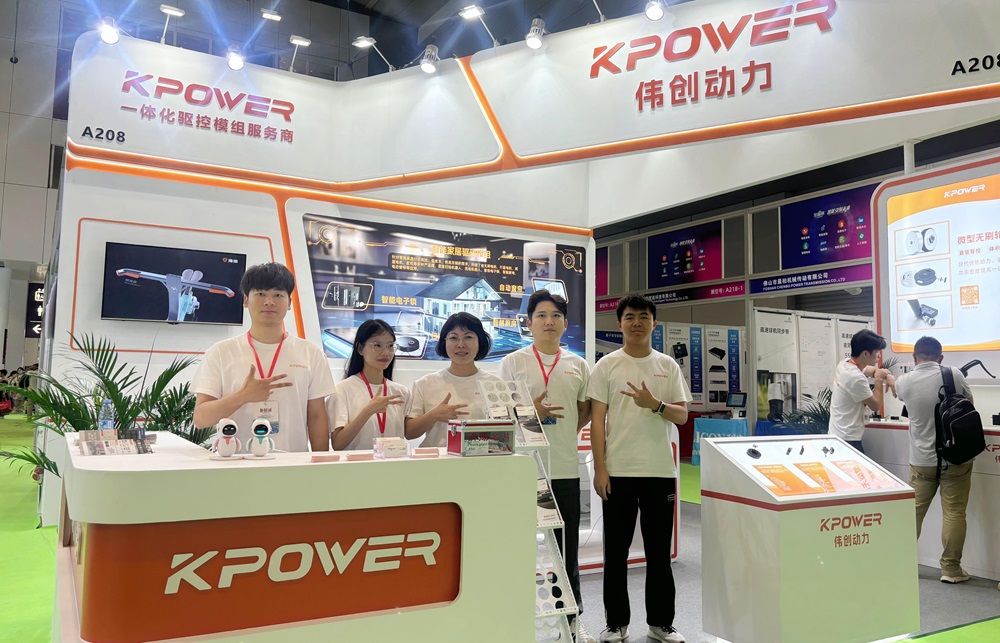
Established in 2005,kpowerhas been dedicated to a professional compact motion unit manufacturer, headquartered in Dongguan, Guangdong Province, China. Leveraging innovations in modular drive technology,kpowerintegrates high-performance motors, precision reducers, and multi-protocol control systems to provide efficient and customized smart drive system solutions. Kpower has delivered professional drive system solutions to over 500 enterprise clients globally with products covering various fields such as Smart Home Systems, Automatic Electronics, Robotics, Precision Agriculture, Drones, and Industrial Automation.
Update Time:2026-01-19

Contact Kpower's product specialist to recommend suitable motor or gearbox for your product.