TECHNICAL SUPPORT


Published 2026-02-19
When playing model airplanes or making robots, the most troublesome thing is that the steering gear "loses its chain". Whether it is adjusting the pitch of a 450 helicopter or installing a simple steering on a model ship, a disobedient steering gear can ruin the good mood of the entire afternoon. Faced with the wide variety of 9gservos on the market, how should we choose and how should we use them to make our small planes fly more steadily and our cars run straighter?
Many novice friends were looking for cheap money when they first started flying, only to find that theservokept shaking and the plane couldn't fly at all. In fact, the requirements for swash plate servos used on helicopters such as Trex 450 are much higher than those for car models and fixed wings. It must not only respond quickly, but also be precise and resistant to interference. A substandard 9g servo will delay the signal when operating at high speed, and the aircraft's attitude will be out of control. Therefore, our first step is to confirm the response speed and no-load current of the servo. These parameters directly determine whether it can keep up with the rhythm of the helicopter.
When choosing, don’t just look at the “9g” weight label. The core depends on its dead zone setting and gear material. The smaller the dead zone, the more accurate the servo's judgment of small signals will be, and there will be no "nodding" problem when hovering. As for gears, although metal teeth are wear-resistant, if the gap is large, it is better to choose precision-fit plastic teeth. My suggestion is to give priority to those models that are marked as suitable for "250/450 helicopters". They are usually optimized for high-frequency vibration environments.
Our boat-playing brothers know this best. When a wave hits, the steering gear will be filled with water and will be scrapped. The shells of micro servos such as SG90 on the market are usually not sealed. But don’t worry, we can do simple protection ourselves. One of the most crude but effective methods is to use a little 704 silicone rubber to coat the seams and bottom outlet of the servo circuit board in a circle. This is splash-proof, but not recommended for diving. It is enough to handle the humidity of daily boating.
For those who play cars, the key point is dust prevention. Dust enters the servo gearbox and grinds the gears like sandpaper, and there will soon be empty spots. You can cut a small piece of thin sponge and stuff it under the rocker arm of the servo output shaft, and then put the servo arm back on. This small "sponge washer" can block most of the dust and fine sand that penetrates through the gaps. The cost is almost zero, but it is particularly helpful in extending the life of the steering gear. It is much less troublesome than disassembling and cleaning it afterwards.
Many people will mutter, can such a small 9g servo mounted on a 1:18 or even 1:10 climbing car pull the big tires? This worry is actually a bit unnecessary. Today's micro digital servos are quite powerful. The key is to look at its torque parameters, which are usually marked in the specification book, such as "1.8kg/cm". As long as this value is enough, it is more than enough to drive the car to turn. Moreover, the small steering gear is light and has little impact on the center of gravity of the vehicle, making the control more flexible.
However, it should be noted that the biggest difference between car and aircraft servos is the frequent "impact". The moment the car hits a rock or lands on the ground, the force will be directly transmitted back to the steering gear. So if you are playing with cars, I would recommend using a 9g servo with metal gears. Although it is a little more expensive, its durability can be doubled several times. If you are playing a high-speed flat road car, you must also pay attention to the centering accuracy of the servo, which determines whether you can run in a straight line. Otherwise, you have to rely on remote control fine-tuning to make up for it.
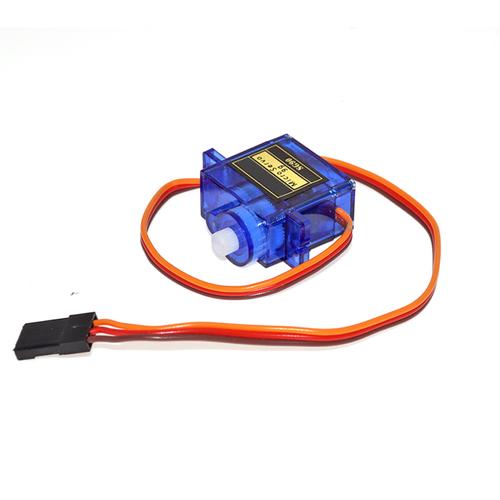
After installing the steering gear, I found that the steering arm was shaking slightly when the power was turned on. This is probably not a broken steering gear, but an installation or setting problem. The most common reason is that the installation angle of the servo arm is incorrect. The correct approach is: first power on the servo (through the receiver), let it return to center automatically, and then install the servo arm at the position closest to 90 degrees. Never install it hard when the power is off, otherwise the mechanical neutral position and the electronic neutral position will not match up, and it will keep competing. Can it stop shaking?
Another cause of jitter is that the connecting rod is not smooth. Check whether the connecting rod from the servo to the control surface is bent and whether the ball joint buckle is too tight. If it is too tight, the servo will have to work extra hard to overcome the resistance, which will cause overload vibration. You can put a drop of silicone oil in the ball head buckle to ensure that it moves freely. Remember, a smooth transmission system can allow a small servo to achieve 200% efficiency, and the flying feel will be clean and neat.
Many friends asked me, the appearance of ordinary servos and digital servos are the same, why is the price doubled? To put it simply, the ordinary servo is like an "honest person". If you give it an instruction, it will execute it. The digital servo is like a "smart guy". It will receive thousands of instructions per second and is always ready to correct the position. This means that the response speed of the digital servo is extremely fast and the locking position is tighter. Only when used in 3D flight can it make crisp and clean rolling movements.
However, digital servos also have disadvantages. They consume more power and require higher signal requirements from the receiver. If your equipment is relatively basic, using a digital servo may cause it to work abnormally due to signal interference. My opinion is that for leisure flying, ordinary servos are completely sufficient and save power. Once you start practicing hovering, brushing, and pursuing precise control, it's not too late to change to a digital servo, and the sense of upgrade will be very obvious.
I'm playing around with the airplane and suddenly it doesn't obey the control. How to judge whether the servo was "honorably sacrificed"? You don’t need a multimeter, you can roughly judge by the feel and taste. Smell it first. If there is a burnt smell, it means the driver chip is burned. Then gently turn the servo arm with your hand. If it can turn easily and there is no damping feeling at all, it means that the gear inside is swept or the motor is detached. If it doesn't turn, as if it's stuck, it's probably because the motor is short-circuited.
If there is just no response, but you can feel resistance when turning the steering arm by hand, it may be that the circuit is broken or the plug is loose. At this time, you can try changing the channel and plugging it in. If it works, the receiver channel is broken; if it still doesn’t work, it is basically certain that the servo has expired. Knowing this, you don’t need to be blinded in the wild, just dismantle and replace with new ones, and continue to enjoy the fun of playing.
Okay, let’s stop talking about the selection and daily use of 9g small servos such as SG90. I don’t know which brand of steering gear you use most often? Have you encountered any weird malfunctions? Welcome to share your experience in the comment area. Let’s communicate together and help more novice friends avoid detours. If you find this article useful to you, don’t forget to give it a like and share it with fellow models around you!
Update Time:2026-02-19

Contact Kpower's product specialist to recommend suitable motor or gearbox for your product.