








TECHNICAL SUPPORT


Published 2026-02-21
Friends who play withservos, whether they are making robots or models, the most troublesome thing is hearing a "click" and theservostops moving, and there is a mushy smell. The burning out of theservomay seem mysterious, but in fact there are only a few reasons. Let's find out these "culprits" one by one today, so that we can avoid these pitfalls in advance in the future.
Many novice friends think that higher voltage can make the rudder move faster. This is a very dangerous misunderstanding. The internal motor and driver chip of the servo are very sensitive to voltage. Once the input voltage exceeds its nominal maximum voltage, for example, if you force a 6V servo to 12V, the internal circuit will instantly overload and heat up. It's like charging a mobile phone with high voltage, and the battery will bulge and be scrapped. Excessive voltage will breakdown the MOS tube in the servo, causing a short circuit in the control circuit. At this time, the servo will not only stop working, but the familiar burning smell is a signal that the internal components are damaged.
This is the most easily overlooked cause of burn-in. When the servo arm is stuck by an external force, or the load that it needs to push exceeds its capacity, the motor cannot rotate but is constantly powered on and "competing". The current at this time will be several times greater than during normal operation. We can imagine that if we hold down the blade of an electric fan to prevent it from rotating, will the motor become hot quickly? This is also true inside the steering gear. Continuous high current will quickly burn the insulation layer of the motor coil, or directly cause the driver chip to overheat and burn. This damage is usually irreversible.
This is a low-level error at the operational level, but it has huge destructive power. There are generally three standard servo wires: brown or black is the negative pole, red is the positive pole, and orange or yellow is the signal wire. If the positive and negative poles are connected reversely, the current will flow into the internal circuit of the servo. It is like connecting the positive and negative poles of the battery directly with a wire. The instantaneous short-circuit current will immediately burn the precise control circuit board inside the servo. Some servos may have reverse connection protection, but most ordinary servos cannot withstand such tossing, and may be scrapped in an instant if they are connected incorrectly.
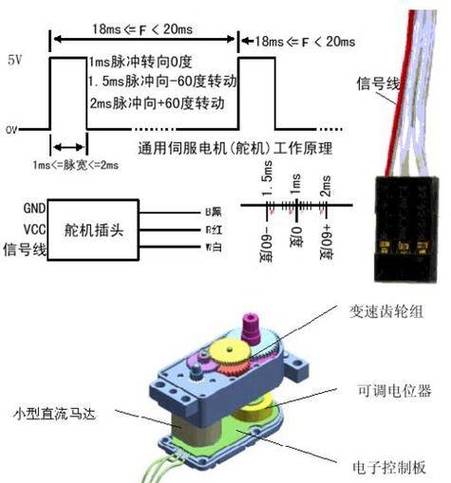
It may sound a bit abstract, but it's there. If the signal from the flight control or receiver to the servo suddenly jumps wildly, causing the servo to swing wildly and rapidly between two extreme positions, then the servo's motor and driver chip will suffer huge physical and current shocks. This situation is like asking a person to suddenly turn sharply and then sprint at a speed of 100 meters. The body will definitely not be able to bear it. In this unstable control state for a long time, the internal gears of the steering gear are prone to tooth sweeping, and the drive chip will also overheat and burn due to frequent commutation current.
The steering gear itself is a heat source when working. Especially when working under heavy load for a long time, the internal motor and driver chip will generate a lot of heat. If the servo is installed in a small airtight space, or the outer shell is wrapped by other things, the heat cannot escape, and the internal temperature will continue to accumulate and rise. Just like if we use a laptop for a long time without ventilating it, it will freeze or even freeze. The performance of the electronic components inside the servo will decrease under continuous high temperature, and eventually it will be permanently damaged due to overheating.
Now that we know so many causes of burnout, we must be careful when choosing a steering gear. Try not to be greedy for cheap and buy those unbranded "three-no" products. Their parameters are often falsely marked, and the protection circuit may also be omitted. When choosing, first look at your application voltage range, and then leave at least 30% margin according to the torque parameters provided by the servo to ensure that it can "pull" without being "tired". Give priority to servos from brands with metal casings and good reputations. These details can often avoid the embarrassment of burning the machine at critical moments.
I wonder if you have ever encountered any strange burning experience when playing with the servo? Is it because it's stuck, or is it smoking due to wrong wiring? Welcome to share your "tragedy" in the comment area. Let's avoid the pitfalls together. By the way, give it a like and share it with more friends.
Update Time:2026-02-21

Contact Kpower's product specialist to recommend suitable motor or gearbox for your product.