







TECHNICAL SUPPORT


Published 2026-02-26
I believe many friends have encountered this problem when tinkering with robots or DIY gadgets: theservowas bought and connected to power, but it just didn't move, or it only turned stupidly in one direction. You want it to move flexibly like a human neck and drive a camera or a small laser pointer to hit wherever you want, but you don’t know where to start. Don't worry, actually making theservogimbal obedient is not as complicated as you think. Today let’s talk about how to control the rotation of thisservogimbal.
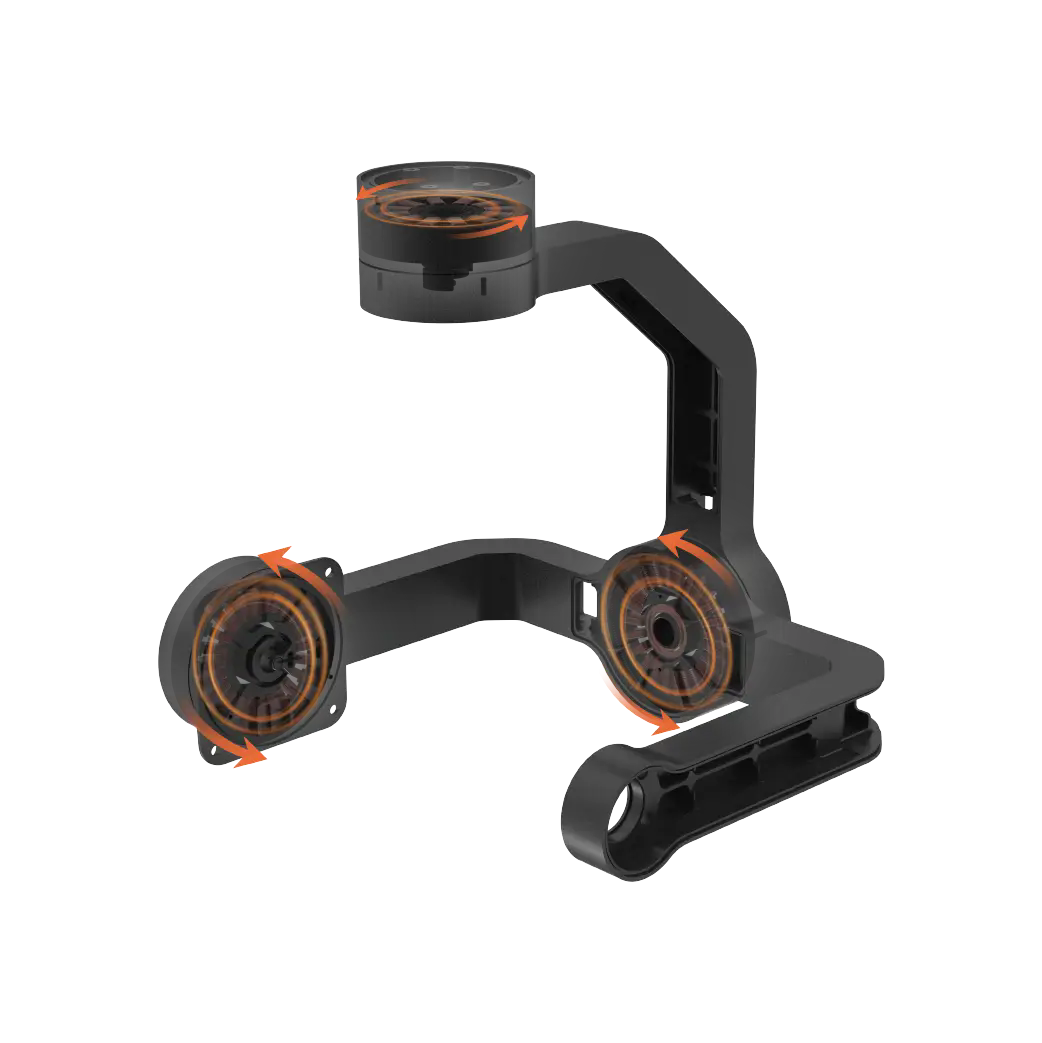
To put it bluntly, a two-axis gimbal can move up, down, left and right, relying on two servos to perform their respective duties. One tube is in the horizontal direction, which is what we often call left and right rotation, and the term is "heading" or "translation"; the other tube is in the vertical direction, that is, when you raise your head and lower your head, the term is "pitch". You must first fix the two servos and build the mechanical structure of the gimbal so that they can be responsible for one direction without interfering with each other. This is just like a human neck. It needs to be able to turn the head left and right and nod. It also relies on different muscle groups. Therefore, the first step to control rotation is to first figure out which direction you want the gimbal to move in, which corresponds to which servo is working.
Many novices get confused when they see the words "control signal" and "PWM" and feel that they are very advanced. In fact, it is very simple. You can think of it as sending a "time command" to the servo. The position of the steering gear's axis is not determined by the voltage, but by a high-level pulse lasting a few milliseconds. Generally, this pulse varies between 1 millisecond and 2 milliseconds. Send a 1 millisecond pulse and the servo will turn to the far left; send a 1.5 millisecond pulse and it will turn to the middle; send a 2 millisecond pulse and it will turn to the far right. For the gimbal to rotate continuously, it depends on your main control board (such as STM32) to continuously send out this pulse 50 times per second, and the pulse width changes slightly each time.
Since the principle is to send pulses, it is very intuitive to implement it in code. On such a platform, you can directly use the ready-made "server library" without having to calculate the time yourself. For example, if you write.write(90), it will automatically generate a pulse that can turn the servo to the 90-degree position. Do you want the gimbal to slowly sweep in a circle from left to right? Write a for loop to slowly increase the angle from 0 to 180, with a little delay in the middle, and the gimbal will spin smoothly. For those who are new to steering gear applications, this is definitely the fastest way to get started. You don't need to understand how the bottom layer generates pulses, you just need to tell the servo "which angle to go to."

If you want to feel more intuitively about "hitting where you point", it would be a very interesting experience to use a potentiometer (that kind of rotating knob) to directly control the gimbal. You can connect the potentiometer to the analog input pin of the microcontroller. The program will continuously read the current position of the knob (such as a value from 0 to 1023), and then "map" this value proportionally to the angle value required by the servo (such as 0 to 180). When you slowly turn the potentiometer by hand, the gimbal's servo will rotate synchronously, as if connected by an invisible connecting rod. This sense of real-time control feedback will give you a deeper understanding of "control".
Of course, hand control alone is not enough. If you want the gimbal to keep itself level or automatically track a target, you need to use an attitude sensor, for example. You can install the sensor on the gimbal, and it will detect whether the gimbal is currently tilted in real time. Once there is an external force to make it crooked, the program will immediately read the deviation data, quickly calculate it through the PID algorithm, and then immediately send an angle correction instruction to the steering gear. The whole process is completed within milliseconds, giving you the feeling that no matter how you shake the base, the camera on the gimbal will always remain motionless, as stable as a mountain. This automatic image stabilization technology is widely used in aerial photography and handheld stabilizers.
I must remind you of a pitfall that is particularly easy to step into, and that is the power supply problem. When the servo is started and loaded, the instantaneous current will be very large. If you use an ordinary microcontroller USB power supply to drive it, the voltage will be pulled down instantly, causing the microcontroller to reset, or the servo to twitch or shake directly. Therefore, do not skimp on your power supply. It is best to prepare an external battery or voltage stabilizing module for the servo with sufficient current output capability, and connect the power ground wires of the microcontroller and the servo together. Only in this way can the entire system work stably, and all your previous codes and control logic can be used.
After seeing this, do you have a better idea of how to control the rotation of the servo and gimbal? From simply sending pulses, to using code to achieve angle control, to adding automatic sensor stabilization, every step can bring you one step closer to your creative product. Want to try it out right now and install a flexible neck on your camera or gadget? If you encounter any problems when selecting a servo or designing a structure, you might as well go to some professional robot forums or company official websites, where there are ready-made solutions and mature products for reference. After talking so much, I was suddenly curious, what interesting projects do you want to use this servo gimbal for? Share it in the comment area, give it a like, and let more hands-on friends see your ideas!
Update Time:2026-02-26

Contact Kpower's product specialist to recommend suitable motor or gearbox for your product.